When a Film Leaves the Page: What Adaptation Actually Changes
Film adaptation changes how a story is delivered, not only what happens: learn to distinguish retained events from reshaped scenes, viewpoint and emphasis.
What does a film adaptation actually change? Film adaptation may keep a novel’s central events while altering how you encounter them: a page can linger inside a thought, while a camera gives you a face, a room or a silence to interpret. The useful distinction is between what happens and how the new form presents it.
Which parts of the story are events?
Start with the plain sequence: a character leaves home, meets an ally, makes a costly choice. These are events, and an adaptation can retain them even if it changes the order, location or circumstances. A familiar plot is not necessarily a faithful experience.
To compare versions, write down a few turning points rather than every incident. Ask what each event makes possible next. If the film removes a meeting but preserves the later decision it prompted, it may have folded that meeting into another scene rather than abandoned its purpose.
That distinction keeps comparison from becoming a hunt for missing furniture. A novel may supply a minor conversation to establish trust; a film might show the characters acting on trust without reproducing the conversation. The event has changed, but the relationship’s role in the story may remain.
What does the new medium make visible?
Prose can report thought directly, move through memory at a sentence’s pace, or describe what a character refuses to notice. Film has other means: framing, performance, sound, editing, colour and the placement of objects. None is a simple substitute for an explanatory sentence.
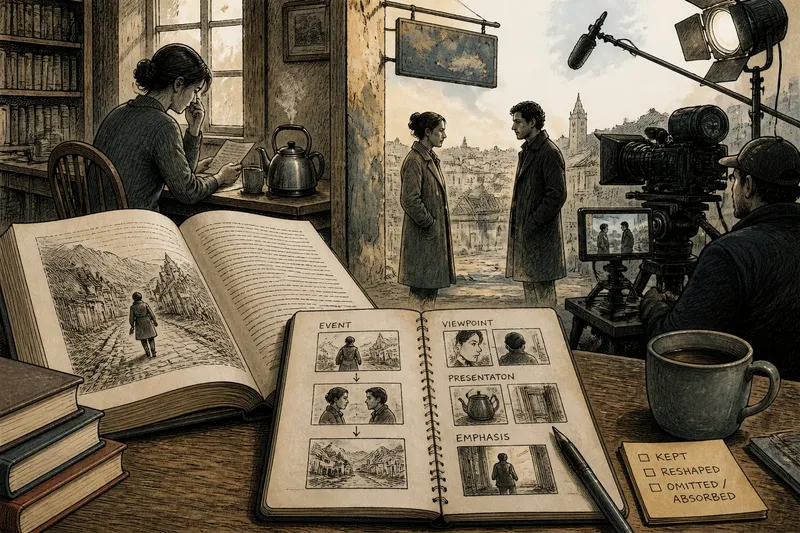
Imagine a novel in which a character rereads an unsent letter and thinks through an old betrayal. In an invented adaptation, the filmmaker keeps the letter, shows the character smoothing its folded edge, then lets a kettle click off in the next room. The expected observable result is that viewers can register hesitation and domestic quiet, while the exact reasoning remains less explicit than on the page.
That is not automatically a loss or an improvement. It is a shift in what the audience must infer. When comparing the scene, note what the book states, what the film shows, and what each leaves uncertain.
Why does viewpoint matter?
A narrator can guide attention with a choice of words, admit uncertainty or conceal information. A camera also directs attention, but its point of view is built from position and duration: what enters the frame, what stays outside it, and when the audience is allowed to see more.
A film might hold on a listener while another character speaks, making the reaction more important than the line. Or it might show a clue before the protagonist notices it, turning private discovery into audience suspense. The scene’s events can be nearly identical while its distribution of knowledge changes the mood.
When a change feels significant, ask who knows what at that moment. This is often more revealing than asking whether the film has preserved every line. Dialogue can survive almost intact and still mean something different when a pause, a close view or a withheld reaction alters its weight.
What gets reshaped, combined or left out?
Adaptations often compress separate characters, move a revelation earlier or replace a long stretch of explanation with one recurring visual detail. These are not merely editing decisions. Each affects how responsibility, suspense and sympathy are assigned.
For a useful comparison, sort changes into three modest categories:
- Kept: an event or relationship still performs much the same job.
- Reshaped: the event remains, but its setting, order, viewpoint or emotional emphasis changes.
- Omitted or absorbed: a passage disappears, or its function is carried by another scene or device.
Then ask what the change makes easier to follow and what it makes harder to notice. Combining two characters may sharpen the plot’s line of action, for instance, but it can also assign one person’s choices to someone else. A scene omitted for pace may have been the story’s only quiet evidence of a friendship.
Not every cut deserves forensic attention. Counting missing sentences, or treating each altered prop as a verdict on fidelity, is usually not worth the effort. Look instead for changes that affect a turning point, a relationship or the audience’s understanding.
How can you compare versions without scoring fidelity?
Use one scene or turning point as a small field note. Record the event, the viewpoint, the medium-specific details and the change in emphasis. Keep the language descriptive before deciding whether a version works for you.
Say you compare a book’s first encounter between two rivals with its film counterpart. The book gives one character’s private suspicion; the invented film version lets both characters notice the same damaged sign, then cuts away before either explains it. You might note that the meeting remains, but the film shifts attention from private judgment to shared uncertainty. That observation is more useful than calling the scene simply faithful or unfaithful.
Adaptation is not a transfer of sealed contents from one container to another. It is a set of choices about where attention goes, how information arrives and which effects the new form can carry. The practical question in any film adaptation is not only what survived, but what the changed presentation asks you to see for yourself.
Which questions clarify a film adaptation?
Does a film have to preserve every plot event?
No. It can remove or combine events while retaining the pressures and decisions that drive the story. The useful comparison is whether the changed sequence still makes the later choices intelligible.
Is a changed ending always a different story?
Not necessarily. An ending can alter the outcome while preserving the central conflict, or keep the same outcome while changing what it means through viewpoint and tone. Consider both the event and the emphasis surrounding it.
How do I compare a book and its film fairly?
Choose a turning point and describe each version in terms of events, viewpoint and presentation before judging it. This avoids treating prose and cinema as if they use the same tools.
What counts as an omission?
A passage is omitted when it no longer appears in the film, but its narrative function may be carried elsewhere. Look for a later scene, image or performance that supplies similar information or emotional context.