The Film Collection That Has Room to Breathe
A film collection with a clear scope is easier to enjoy and maintain. Use one personal organising question to decide what belongs and what can stay out.
Your film collection has acquired three editions of the same title, a handful of discs you cannot place, and a shelf that seems to be making a quiet argument. A clear scope can help. The useful question is not how many films you own, but what you want the collection to hold together. A film collection with a clear scope gives you a reason to keep some things and leave others outside it.
That reason should be personal enough to guide decisions and plain enough to remember. It might be “films I return to for their city settings” or “screen versions of stories I have read”. The point is not to build a system that looks impressive in a spreadsheet. It is to make collecting feel deliberate again.
Why does the collection keep expanding without a shape?
A collection can grow by several small accidents: a gift, a sale, a favourite actor, an interesting cover, a recommendation, a title picked up because it was available. Each choice may make sense alone. Together, they can leave you with a shelf that records every passing curiosity but says little about what you value.
The usual cause is that the buying rule is implicit. “I like films” is true but not selective; it permits almost anything and gives no help when space or attention is limited. A scope turns a broad affection into a collecting premise, such as “films whose settings shape the story” or “comedies I can watch with my family”.
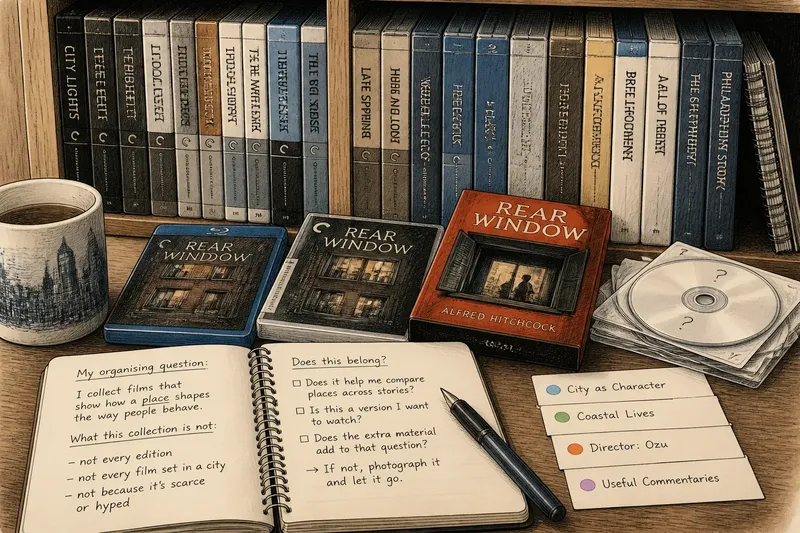
Try writing one sentence that begins, “I collect films that…” Make it about a quality you notice, a question you keep returning to, or a relationship between films. If the sentence needs several clauses, it may be trying to justify too much. A collection can have more than one shelf, but each one benefits from a reason of its own.
What makes a useful organising question?
A useful question helps with a real decision. “Does this film belong to the collection?” is not much help until “belong” has a meaning. “Do I want to compare this film’s use of a particular setting with the other films I keep?” is more revealing, because it asks whether the object contributes to a conversation you want to have.
Choose a question that interests you even when you are not shopping. For instance: “How do films make a familiar place feel strange?” or “Which films do I want to revisit with someone who has not seen them?” A question tied only to a current bargain is liable to change as soon as the bargain does.
It can also help to name what the collection is not. A collection about a director’s films need not include every item connected to that person; a collection about a genre need not absorb every film that borrows one of its conventions. Boundaries are not a criticism of the films left out. They are what make the chosen group legible.
Why does every interesting edition seem to qualify?
Collectors often slide from collecting films to collecting all the things attached to films. A special case, booklet, soundtrack, poster or alternate release can be appealing in its own right. But if the scope concerns the films and the questions they raise, packaging alone may not add anything to that purpose.
Before acquiring an edition, ask what it contributes. Does the booklet help you compare the film with another work in the collection? Is the disc a version you specifically want to watch? Does the sleeve mark a meaningful release or simply look handsome on a shelf? A “yes” need not be elaborate, but it should be yours rather than the marketing copy’s.
Imagine you collect films in which a house changes the way a family behaves. You find an edition of a film already on your shelf, with a new cover and a booklet about the production. If the booklet helps you think about domestic spaces in the collection, you may decide it belongs; if you only want to see the cover, you might save a photograph of it and leave the edition for someone collecting release designs. Either choice is coherent once the organising question is clear.
Not worth the effort: trying to own every edition of a film merely to prove completeness. Completeness is meaningful only against a defined set, and the set should be one you actually care to maintain.
What if the collection has several themes already?
Several interests do not automatically need to be forced into one grand idea. You may collect films by a particular director, films set in coastal towns, and discs with useful commentaries. Those are different reasons for keeping things. Treating them as separate strands can be clearer than inventing a theory that makes every item seem related.
Give each strand a short name and a practical boundary. “Films set by the sea” is still broad, so decide whether a brief beach scene counts or whether the setting must shape the story. “Director editions” might include only films directed by that person, rather than acting appearances, production credits and every related interview. The boundary prevents a category from turning into a trapdoor.
Keep an item in more than one strand if it genuinely answers more than one question. A film can belong to a setting group and a director group without requiring two physical copies. A simple catalogue or shelf label can record both connections; the collection need not multiply objects to acknowledge them.
How do you decide what can stay outside?
“Outside” is not the same as “bad” or “unwanted”. It means the item does not serve this collection’s present purpose. That distinction can make it easier to decline a purchase, accept a gift without keeping it, or pass along a title you enjoyed but do not need to own.
When you are unsure, ask whether the item creates a useful connection to something already present. It may fill a gap in a comparison, offer a different version, or make an existing question more interesting. If the answer is only that it is well regarded, scarce, or currently tempting, that may be a reason to watch it, not a reason to collect it.
Say you keep films that show how a neighbourhood changes across a story. You are offered a disc of a film set in a city, but its streets are incidental and the collection already has no question it would help you pursue. You might borrow or stream it instead, then reconsider if it becomes relevant to a future comparison. The observable result is a collection that keeps its focus without pretending the film has no merit.
What if a film collection has no space left?
A full shelf often exposes a scope problem, but it can also expose a storage problem. First separate the two. If most items still answer your organising question, the collection may need a different arrangement. If many do not, making more room will preserve the disorder in a more spacious form.
Group films by the relationship that matters to you, not by whichever case is easiest to spot. A small shelf label, a handwritten list, or catalogue fields for theme and format can make the logic visible. Keep the system modest: a catalogue that takes longer to maintain than the collection takes to enjoy is a hobby acquiring clerical duties.
For duplicate editions, decide which one serves the scope and what the others add. A disc with a preferred version may be the one to retain; an extra copy with no distinct content may be easier to give away. For fragile paper inserts or posters, store them separately in suitable archival sleeves rather than wedging them into cases that bend them. Follow the maker’s storage guidance for media and materials, and seek specialist advice for valuable or delicate items.
Which questions help settle a collecting decision?
Should I keep films I have not watched?
Only if they fit the collecting question and you genuinely intend to explore them. An unwatched disc can be a promising part of a collection, but an ever-growing queue may be a sign that buying has replaced viewing.
Can a collection include films I dislike?
Yes, if the film helps you examine the subject of the collection. A collection about a genre, setting or adaptation may benefit from a title you find irritating, provided you know why it belongs.
How often should I change the collection’s scope?
Change it when your question no longer helps you choose, not merely because a new film has caught your attention. You can record the old scope and begin a separate strand rather than rewriting the collection around every fresh enthusiasm.
Do I need a catalogue to keep the collection coherent?
No. A visible shelf arrangement and a remembered organising question may be enough for a modest collection. A catalogue becomes useful when it helps you find titles, spot duplicates or understand connections you would otherwise forget.
How can the scope stay useful as your taste changes?
Let the question be stable enough to organise the collection, not so rigid that it becomes a rule you obey out of duty. You may discover that a collection about city settings is really about who gets to feel at home in a place. That is a meaningful refinement if it changes what you notice, rather than a clever label applied after the fact.
Review the collection when you add a shelf, sort a box, or realise you cannot explain why several items are there. Keep a short note beside the catalogue or inside a cupboard door: the question, the boundary, and any exception you have chosen to allow. An exception can be useful, but naming it stops exceptions from becoming the whole policy.
A film collection with room to breathe is not necessarily small. It is one whose owner can say why the films sit together, what a new addition would contribute, and what can be enjoyed without being owned. That answer may shift over time; the shelf does not need to pretend otherwise.